US industrial production August 2026: machinery output up 6.3% while factory output fell, and why an American lead time is now a negotiating position
75.7 per cent.
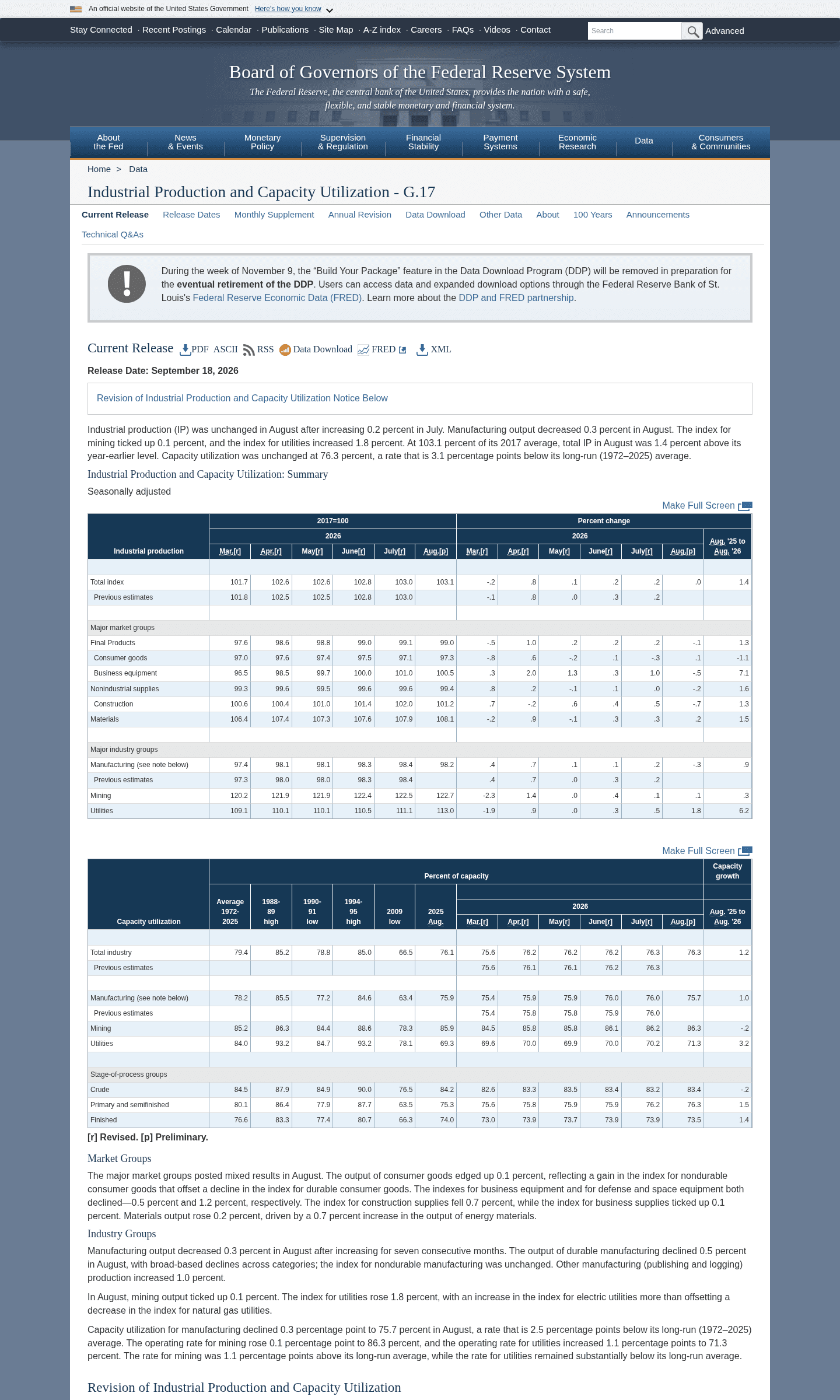
That is how much of American manufacturing capacity was actually in use in August, and it is the number to carry into your next conversation with a US supplier. The Federal Reserve published it on 18 September in the G.17 release, alongside a headline that reads worse than it is: industrial production unchanged on the month, manufacturing output down 0.3 per cent after seven consecutive monthly increases.
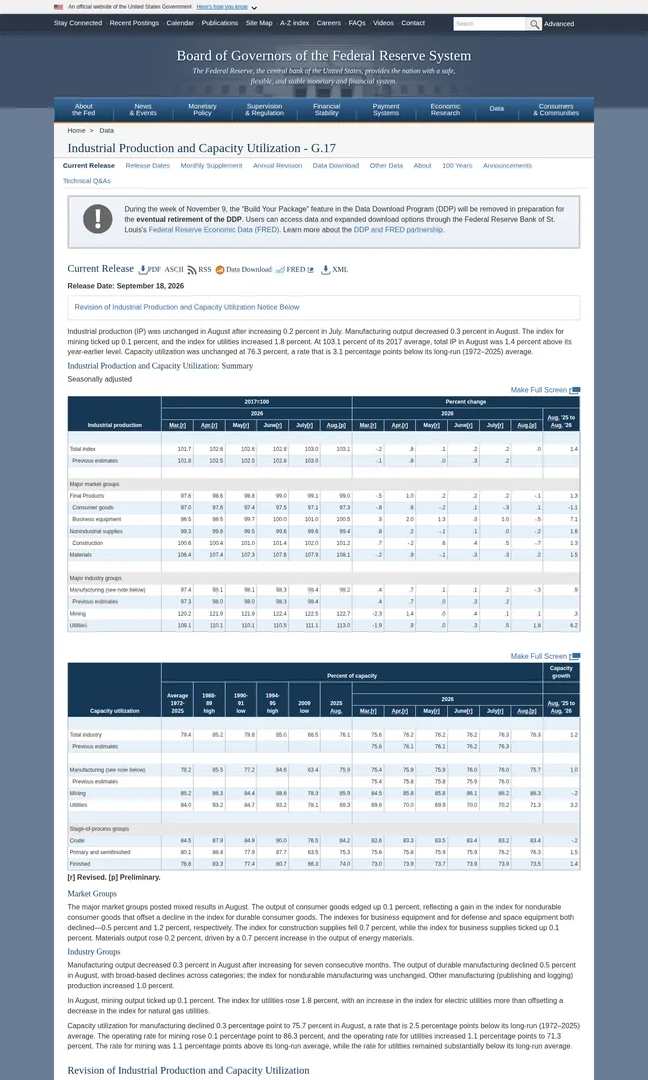
The seven-month streak ending is the sentence the wires ran with. It is not the sentence that changes a purchase order. This one does: the part of American industry that builds capital equipment kept growing while the part that builds consumer goods did not.
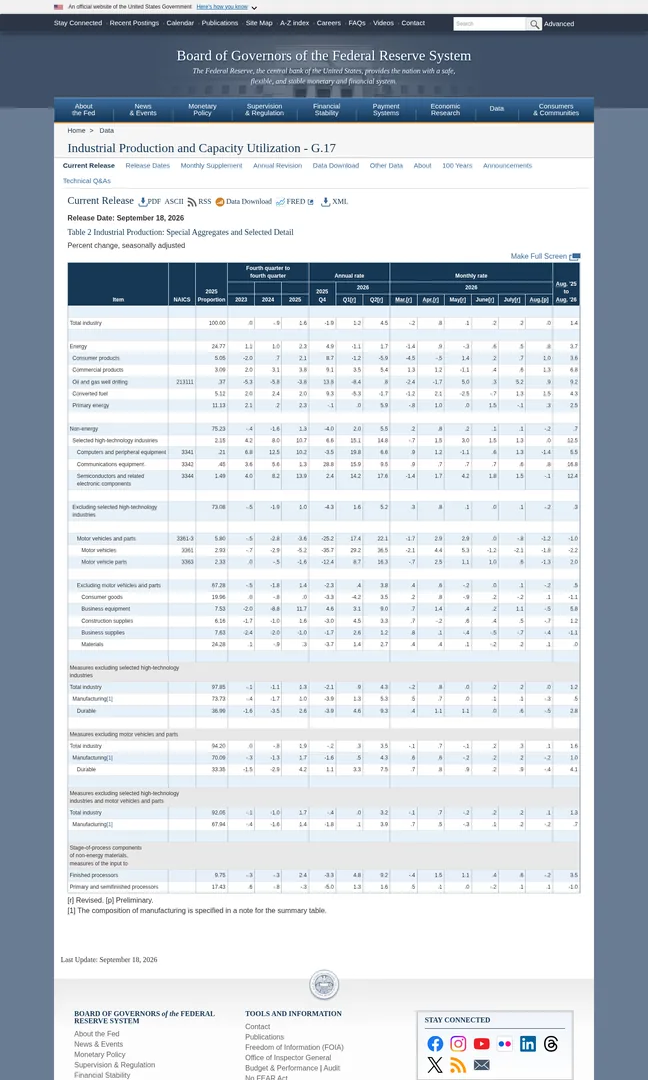
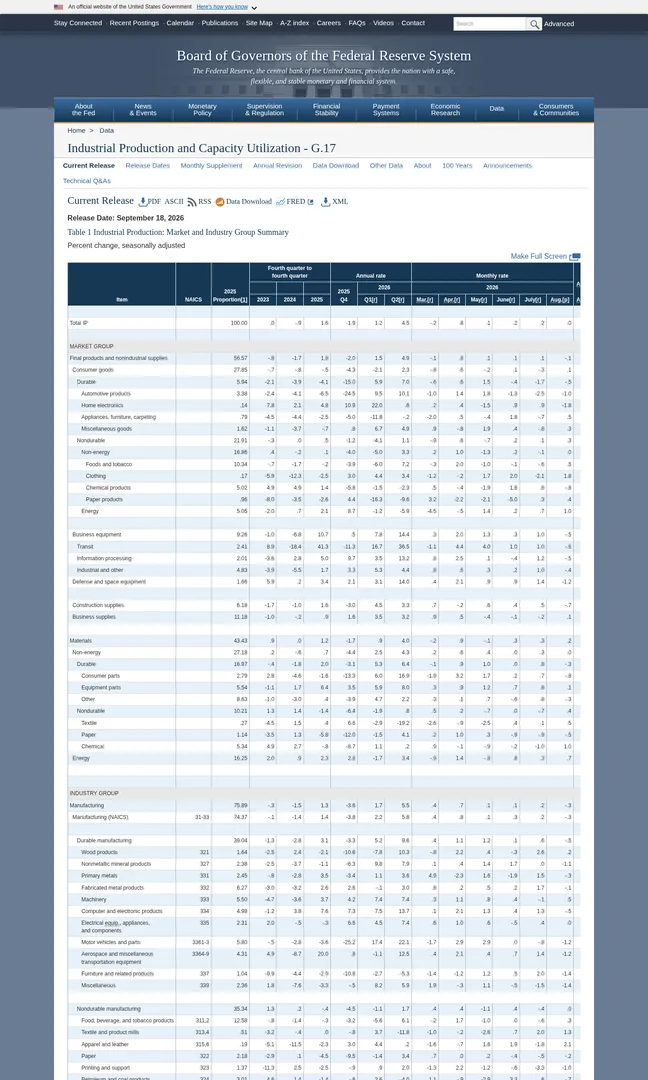
| Industry (NAICS) | Aug m/m | Aug '25 → Aug '26 |
|---|---|---|
| Machinery (333) | +0.5% | +6.3% |
| Computer & electronic products (334) | −0.5% | +8.7% |
| Fabricated metal products (332) | −0.1% | +3.6% |
| Primary metals (331) | −0.3% | +0.5% |
| Motor vehicles and parts (3361–3) | −1.2% | −1.0% |
| Nondurable manufacturing | 0.0% | −1.5% |
| Manufacturing (31–33) | −0.3% | +1.0% |
Source: Federal Reserve G.17, Table 1, 18 September 2026.
Machinery ran at a 7.4 per cent annual rate in the first quarter and 7.4 per cent again in the second. Business equipment as a market group is up 7.1 per cent on the year. Nothing in that describes a machine-building sector short of work — but nothing in it describes one short of room, either.
What 75.7 per cent does to a lead time
| Aug 2026 | 1972–2025 average | Gap | |
|---|---|---|---|
| Manufacturing | 75.7% | 78.2% | −2.5 pts |
| Total industry | 76.3% | 79.4% | −3.1 pts |
| Mining | 86.3% | 85.2% | +1.1 pts |
| Utilities | 71.3% | 84.0% | −12.7 pts |
Manufacturing capacity itself grew 1.0 per cent over the year. Capacity up, utilisation down, output on the capital-goods line still rising: that is a sector with slack in it.
So when an American supplier comes back with sixteen or twenty weeks on a machine, a fixture package or a spares kit, the lead time is not a capacity fact. It is an order-book fact, a scheduling fact, or a shipping fact — and each of those is negotiable in a way that a full shop floor is not. Ask which one it is. Ask it in writing, against the line item. A supplier running at three-quarters of capacity that cannot name its constraint is quoting you a queue position, not a build time, and queue positions move for buyers who ask.
Next to Pakistan's own table
US primary metals are up 0.5 per cent on the year and fabricated metal 3.6 per cent — flat, in other words. Pakistan's own July index, which we read here yesterday, had billets down 32 per cent. Two metal sectors going nowhere at the same time is not a squeeze on either side; it is why the bar stock argument this quarter is about origin and certificate, not about a shortage.
One date to diary. The Fed rebases the whole series to 2022 on 24 November and revises every industry index back through the history. Every figure above is provisional until then, in a specific and dated way — which is a fair thing to say to a supplier who quotes an American statistic back at you.
My read, and it is a view, not a forecast: machinery holds above +5 per cent year on year in the September G.17, and manufacturing utilisation stays under 76.5 per cent, when that release lands in the middle of October. Two straight quarters at a 7.4 per cent annual rate do not stop inside one month, and capacity is still being added. If both hold, treat any US machinery lead time past twelve weeks as an opening position and say so. If machinery drops under 5 per cent, I am wrong, the slowdown has reached the capital-goods line, and the conversation changes to price instead.
Sources
- Industrial Production and Capacity Utilization — G.17, Federal Reserve Board, released 18 September 2026 — headline, industry groups, capacity utilisation and the revision notice.
- G.17 Table 1 — Industrial Production: Market and Industry Groups, Federal Reserve Board.
- G.17 Table 2 — Capacity Utilization, Federal Reserve Board.
- Pakistan LSM July 2026: billets down 32%, trucks up 94%, Vesprr, 22 September 2026.