Skip to content
Brent at $107, diesel at Rs 398 and a container index that did not move: where a $100 barrel lands on an industrial cost sheet
Back to Blog

Brent at $107, diesel at Rs 398 and a container index that did not move: where a $100 barrel lands on an industrial cost sheet

Sadaf Masood

Brent settled at $107.63 on Thursday 10 September, up 6.3% in a day and more than 18% in the month, and Pakistan's ex-depot diesel price has been raised four mornings in a row — Rs 398.04 a litre from today, Rs 19.99 more than it was on Monday. The container index did not move. That is the whole cost sheet in three numbers: fuel has repriced this week, freight has not yet, and the forecast everyone was quoting a week ago is already $17 wrong.

This is not about the war. It is about which lines on an industrial cost sheet move with a $100 barrel inside a week, which move with a lag, and what to write into a quotation whose input can move 6% between the morning it is sent and the morning it is accepted.

Five days, in numbers

DateBrent settle (US$/bbl)Pakistan HSD ex-depot (Rs/litre)Daily changeDrewry WCI (US$/40ft)
Mon 7 Sept378.05 (implied by BR's four-day total)
Tue 8 Sept381.77+3.72
Wed 9 Sept101.21 (+3.4%)385.95+4.18
Thu 10 Sept107.63 (+6.3%)392.67+6.724,476 (flat, 2nd week)
Fri 11 Sept398.04+5.37
Four days+18% in September+19.99 (+5.3%)0%

Sources: CNBC (9 and 10 Sept settles); Business Recorder notifications for 9, 10 and 11 Sept; Aaj News for 8 Sept; Drewry World Container Index, 10 Sept. Brent was $87.16 a month ago and $67.91 a year ago (Fortune, 10 Sept).

Read the diesel column against the Brent column and the mechanism is visible. Pakistan moved from weekly to daily petroleum pricing on 18 July, according to Business Recorder's editorial of 10 September, and BR Research wrote on Friday that the formula runs on a seven-day rolling average. So the domestic price is a smoothed, one-week-lagged copy of the international one. Thursday's 6.3% jump in Brent is not yet fully in Friday's Rs 398.04; it will keep arriving through next week even if crude goes nowhere from here.

Motorcyclists and a van queue at a PSO forecourt in Pakistan under a Dawn News caption reading petrol, diesel prices increased
From Pakistan Raises Petrol Price by Rs5.58, Diesel by Rs4.18 | New Fuel Prices From Sept 9 by DawnNews English

The forecast that was wrong within a day

The US Energy Information Administration published its September Short-Term Energy Outlook on 9 September. Its inputs were frozen on 3 September, and it says so: "This month's forecast does not specifically account for market events after that day." Brent averaged $91 in August; the STEO forecasts "around $90/b in 2H26" and $74 in 2027. Thursday's settle was $17.63 above the second-half forecast, one day after it was published.

Two of its lines are still the ones a buyer should keep. It expects Middle East crude production to stay "below pre-conflict averages until the second quarter of 2027" — that is the lead-time statement, and it says this is not a two-week event. And it expects US distillate inventories to drop below 100 million barrels this month and stay below the five-year low "through much of 2027". Diesel is the tight product, not crude. The EIA raised its 2026 distillate crack-spread forecast to $1.57 a gallon from $1.30 in August, a 20.8% revision in one month, and its US retail diesel forecast to $5.07 from $4.85. It also had to issue a correction, because the first version of that table printed the gasoline crack numbers under the distillate label. A 20% revision and an erratum in one release is a fair summary of the state of forecasting.

Bank of America's Francisco Blanch said on CNBC on Thursday that "the biggest source of pain right now is the diesel market". Economics Help's video from three days ago makes the same point from the other side — its title card reads "not an oil shock", and the argument is that the crack spread, not the crude price, is what has moved. A machine shop does not buy Brent. It buys diesel, road freight priced on diesel, and electricity whose fuel component is set with a lag.

What moves in a week, what moves in a quarter

Split the cost sheet by how fast each line follows the barrel.

Cost lineFollows crude withinThis week's evidenceWhat to do Monday
Diesel at the pump (Pakistan)1–7 days (daily notification, 7-day average)Rs 378.05 → 398.04 in four daysIndex any fuel surcharge to OGRA's daily HSD notification, not to a monthly figure
Generator running hoursSame day as dieselOur estimate: about Rs 677 an hour for a 4.5 kW rated set at Friday's price, Rs 34 more than MondayLog generator hours per job; the cost is now a line, not an overhead
Road haulage (local)Days to weeks, by contractNo published index; transporters reprice on the notificationAsk what diesel price the contracted rate assumes and write the reset rule down
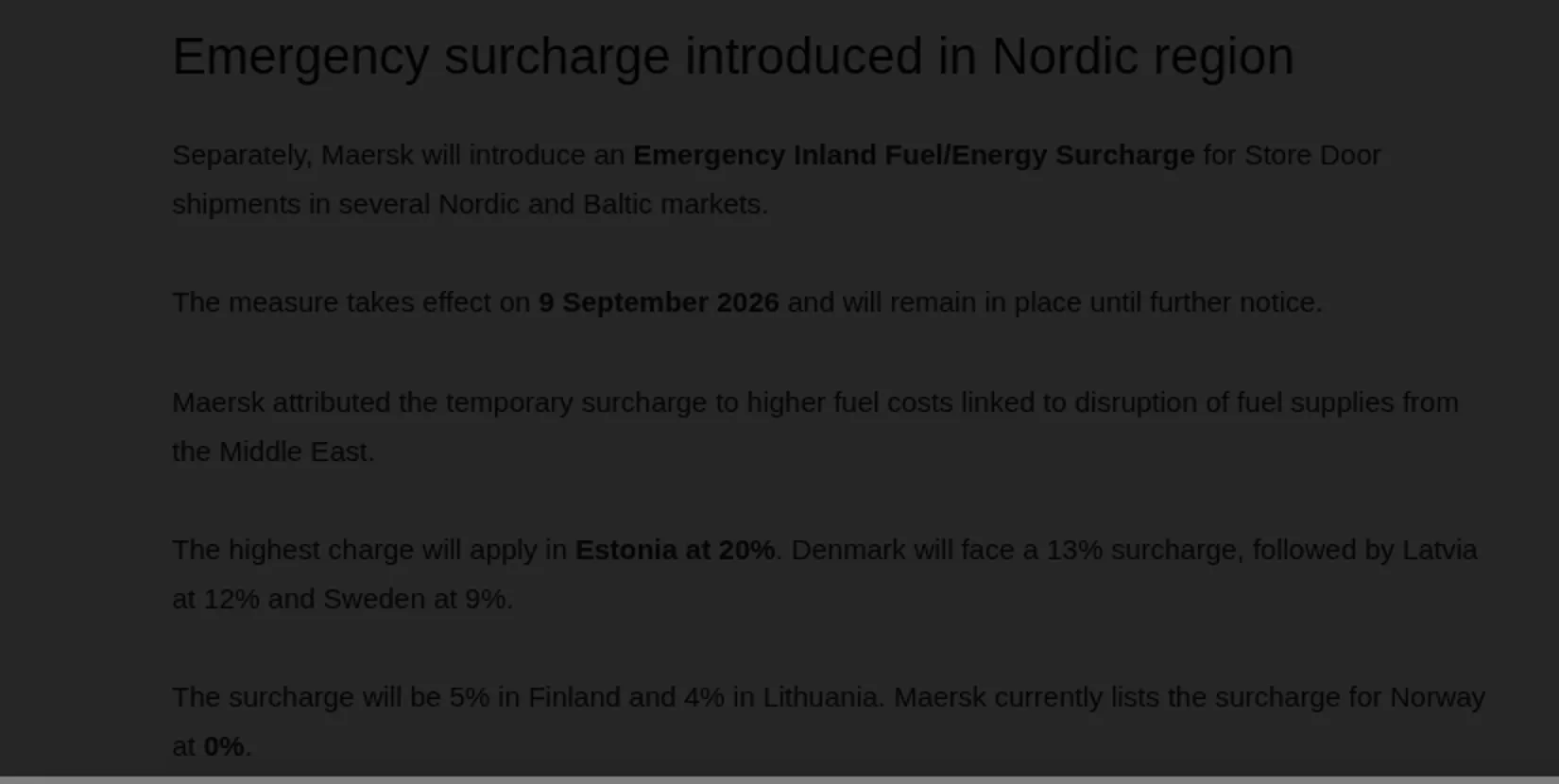
Ocean freight, Asia–Pakistan and Asia–EuropeWeeks to a quarter, via bunker adjustment factorsWCI flat at $4,476 for a second week; Shanghai–Rotterdam down 2% to $3,997Do not pull orders forward for freight reasons; check the BAF clause in the carrier or forwarder contract
Electricity (Pakistan)Monthly, via the fuel price adjustmentNot yet visible in a tariffExpect the adjustment to follow; quote long jobs with an energy clause
Steel, aluminium, energy-intensive inputsWeeks to months, via mill surchargesNo surcharge notices yet this weekRe-read the 8 September steel piece; ask mills whether their price is fixed to a delivery date

The generator figure needs its working shown, because the manufacturer does not publish fuel consumption. TOTAL's TP250001 silent diesel set, stocked in the tools catalogue, is rated 4.5 kW on a 418 mL air-cooled single-cylinder diesel. A comparable 418 mL engine from another maker, ETK Power's 186FA, publishes 273.5 g/kWh at 3,000 rpm. At full rated electrical load, allowing for alternator losses, that is roughly 1.7 litres an hour, which at Rs 398.04 is about Rs 677. The same hour on Monday's price was about Rs 643. That is an estimate built from a comparable engine, not a TOTAL figure, and the tools site will carry the full working today.

Why freight has not moved, and why that will not last

Drewry's World Container Index for 10 September held at $4,476 per 40ft for the second consecutive week. Shanghai–Los Angeles rose 2% to $7,352 and Shanghai–New York 1% to $9,726; Shanghai–Genoa fell 3% to $4,216 and Shanghai–Rotterdam 2% to $3,997. Drewry notes eight blank sailings announced on the transpacific for next week, up from seven, and expects rates "to remain stable next week". Carriers are holding rates by cancelling capacity, not by raising them.

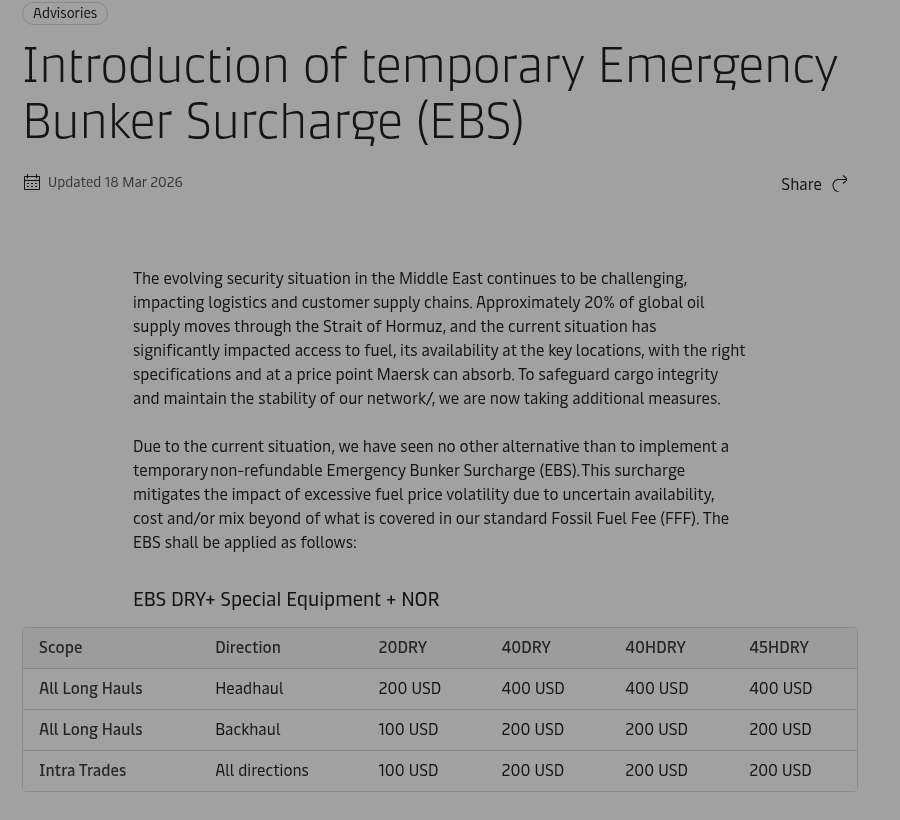
Spot rates do not carry bunker cost day to day; the bunker adjustment factor in a contract does, on a schedule. The number that will move freight is not Brent but the tanker count. Business Recorder's editorial puts Hormuz transits at somewhere between fifteen and one or two tankers a day against 140 to 150 before 28 February. CNBC reported the US Navy had destroyed at least eight Iranian tankers since Saturday. Goldman Sachs' Daan Struyven told CNBC on Wednesday that Brent above $120 is now "plausible" if attacks on shipping intensify — Goldman's base case is still a gradual recovery in Gulf exports, and the $120 is a risk scenario, not a forecast. Treat it that way. But if it arrives, the freight column stops being flat.

Title card from an Economics Help video showing a refinery at night with the words not an oil shock and a rising red arrow
From Why Diesel Is Breaking the Economy by Economics Help

The Rs 85 that does not move with Brent

One number in the Pakistani price is worth separating out. BR Research reports the combined petroleum levy and Climate Support Levy at Rs 85 a litre on both petrol and diesel, and Business Recorder's editorial gives the dealer margin at Rs 9.98 a litre after this year's increase from Rs 8.64. So of Friday's Rs 398.04, roughly Rs 95 is tax and margin that does not follow crude, and about Rs 303 does. When you build a fuel-escalation clause, index it to that Rs 303, not to the headline. Otherwise a 10% move in crude is written into your contract as a 10% move in the pump price when it is closer to 7.6%.

BR Research also reports a rumour of pulling the HSD pricing benchmark back towards $30 a barrel, unconfirmed by Islamabad and opposed by refineries. With the IMF in town for a programme review and Rs 1.67 trillion of petroleum levy in this year's budget, the levy is not coming down. Plan on the notification, not on relief.

What to write into the quote

Three things, in order of how much money they protect.

Validity. A quotation with meaningful diesel, generator or haulage content should now be valid for seven days, not thirty. If a customer needs thirty, price the option: the four-day move this week was 5.3% on diesel.

Escalation. Name the index. "OGRA notified ex-depot HSD price, Rs/litre, on the date of dispatch" is a clause both sides can verify in the newspaper. "Subject to fuel price changes" is not a clause; it is an argument waiting to happen.

Freight. Leave ocean bookings alone. The WCI says the second wave has not started. Check the BAF reset date in the contract and diarise it.

The EIA's own line is that Gulf output does not normalise before the second quarter of 2027. The 7-day rolling average will keep handing out Rs 4 and Rs 6 increments while that is true. The buyers who come out of this with margins intact are the ones whose quotes already say what happens when the number changes.

Vesprr machines, welds, supplies tools and builds software from Taxila, and every division is repricing this week. If you need a quotation that states its fuel assumptions, ask for one.

Sources