Quoting steel work when the plate price will not sit still
Quote it as two lines with two validity dates. Labour and fabrication can be firm for the thirty days your customer needs; material should be priced on the day the order is placed, or held firm for seven days against a lot you could actually buy this morning. What does not survive the quarter is one all-in figure carried for a month, because the steel half of it was never yours to fix.
Your stockist's number is not an opinion you can argue down. It is the landed cost of a consignment he has already paid for, converted at the rate on the day he bought it, plus freight, duty and clearing. That is why two honest traders quote differently on the same morning, and why a rate you were given three weeks ago may simply no longer exist.
Where the number is actually set
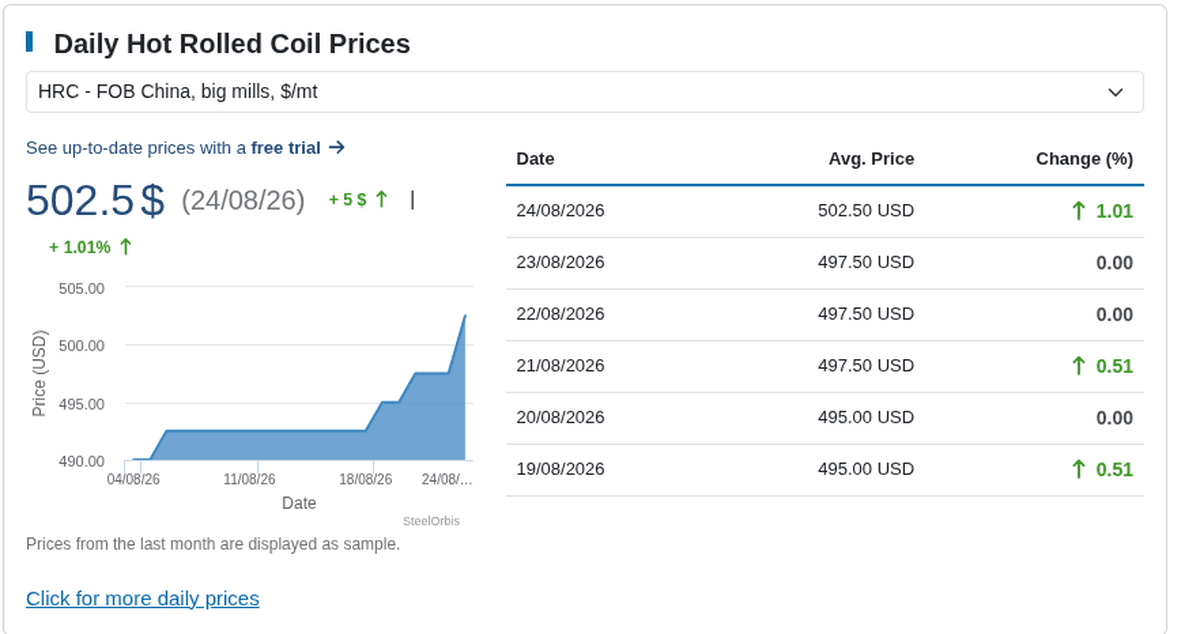
Three inputs move it and none of them is local. The first is the export mill's offer: SteelOrbis' daily series for hot-rolled coil, FOB China big mills, printed $495.00 a metric ton on 19 and 20 August and $502.50 on 24 August, the most recent prints it publishes openly. The second is the exchange rate on the day the coil was bought, not the day you are quoting. The third is freight, duty and clearing, which do not shrink when the mill price rises — so a $30 move at the mill arrives at the warehouse as a $30 move, not a diluted one.
All three point the same way into the fourth quarter. Baosteel has raised its domestic hot-rolled price by 200 yuan a ton, about $30, for October deliveries, on coking coal and other raw materials and the expected autumn restock; MySteel reads it as the company's largest upward adjustment since it did the same for April. ArcelorMittal has put European hot-rolled coil up €20 a ton for November. And the American market, where hot-rolled coil averaged $1,205 a short ton at the start of September, is where an exportable ton goes first. Where a country has no hot strip mill of its own — Pakistan imports every ton of hot-rolled coil it uses — there is no domestic list price underneath to anchor a quotation against.
What to ask before you fix a number
- Which consignment is this quoted from, and when did it land? A rate against stock in the yard and a rate against material still on the water are two different prices wearing the same name.
- Duty-paid or ex-bond? That difference is not a rounding error, and it decides who carries a duty change between order and clearance.
- Grade and mill test certificate, with the heat number, before the plate is cut. Where the work is welded or load-bearing the grade belongs on the paperwork, not in the conversation.
- How much tonnage is being held for you, and until when. A price with no tonnage behind it is an indication, and indications move.
If a customer insists on a single firm figure for thirty days, it can be done: buy the steel when the order is signed rather than when you cut it, and price the cost of holding it into the quotation. The risk has not disappeared, it has been moved onto your own balance sheet deliberately, which is a decision rather than an accident. The version that bankrupts people is the one where nobody noticed the exposure was there.
Vesprr Workshop cuts, machines and fabricates to drawing. Send the drawing and the tonnage and the quotation comes back as material and labour on separate lines, each with its own validity date.
Sources
- SteelOrbis, Hot Rolled Coil Prices, News and Analysis: daily HRC FOB China big mills, the 19–24 August prints shown in the public sample, read 24 September 2026.
- Halina Yermolenko, GMK Center, 11 September 2026: Baosteel is raising its prices for hot-rolled coils by $30/t for October sales, citing BigMint and MySteel — the 200 yuan rise, the comparison with April, and ArcelorMittal's €20 November increase.
- Halina Yermolenko, GMK Center, 9 September 2026: Nucor has raised the price of hot-rolled coils to $1,190 per tonne — Steel Market Update's $1,205 a short ton average at the start of September.
- Raw Easy Corp, Karachi: Hot rolled coil and its per-ton rate list — no mill in the country rolls HRC, and what that does to how an imported coil is quoted.