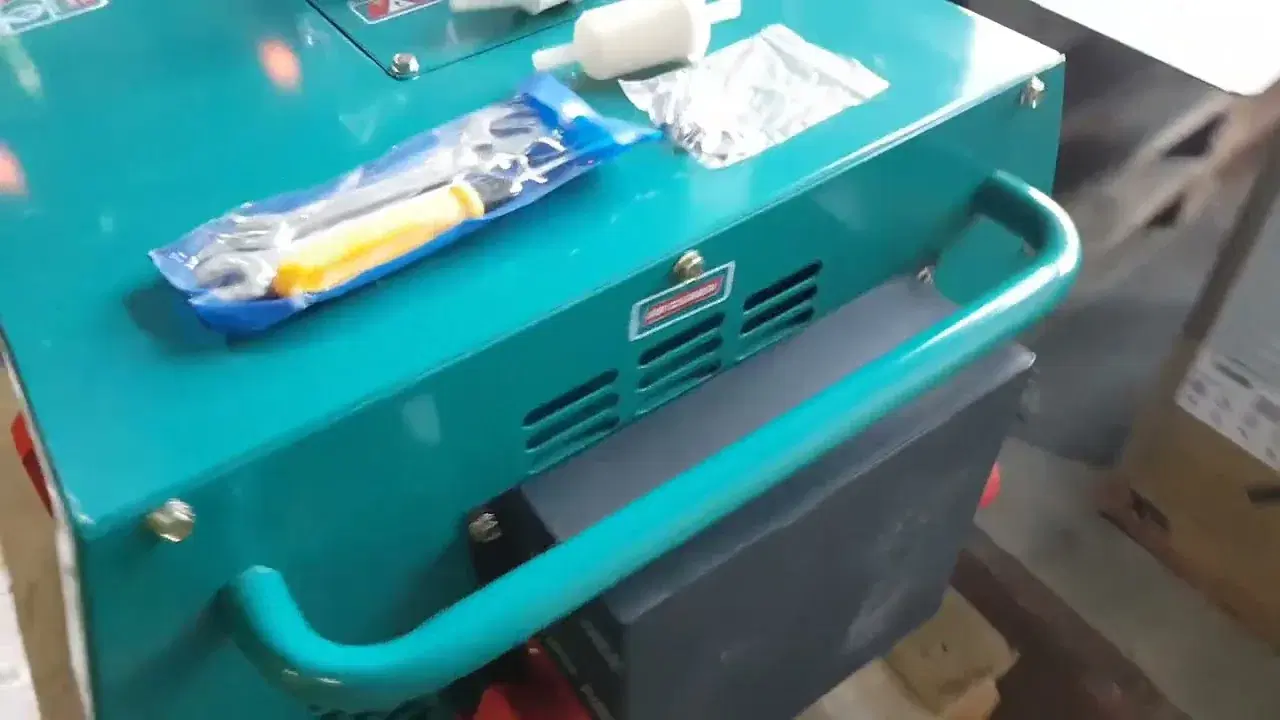
Fuel keeps moving: quote generator hours in litres
Put litres on the quote, not currency. A generator's fuel burn is fixed by its engine and the load you put on it; the only thing that moves between the day you quote and the day you dispatch is the price of a litre. So state the burn rate and the hours, and index the rate you charge to the pump price notified on the date of dispatch. The customer can check that figure themselves, and you stop absorbing every rise mid-job.
Working out your own set's litres per hour
Most generator makers publish no fuel figure at all, so you build one from the engine. You need three things: the engine's specific fuel consumption in grams per kilowatt-hour, the alternator efficiency, and the density of diesel. Then litres per hour is the kilowatts you are drawing, divided by alternator efficiency, multiplied by the grams per kilowatt-hour, divided by the grams in a litre.
Worked through on a common small set: the 418 mL, 9 HP engine class behind a 4.5 kW rated canopied diesel is quoted at 273.5 grams per kilowatt-hour at 3,000 rpm. Take the alternator at 85 per cent and diesel at 0.84 kilograms a litre, and full rated load comes to about 1.7 litres an hour. At the 70 per cent average that a set on a varying load actually sees, about 1.2 litres. At half load, about 0.9.
Two cautions on those numbers. They come from a comparable engine's own datasheet rather than the generator maker's, and they flatter the part-load rows, because a small diesel burns proportionally more when it is loafing. Treat them as a floor and check your own consumption against the tank over a week of real work: hours run against litres put in is a better figure than anything on a sheet.
Once you have your litres per hour, the fuel line on a quote reads as a rate and a count — so many litres an hour, so many hours, priced at the notified rate on the day of dispatch. A forty-hour job then re-prices itself automatically, and nobody argues about it.
Why the price is unlikely to unwind
The usual reason to absorb a rise rather than index it is the expectation that it will come back. Japan's customs table for August is the clearest public evidence against that, because Japan runs its refineries on imported crude and buys at scale, so what it paid is close to what everybody paid.
Japan landed 11,594 thousand kilolitres of crude in August, 3.6 per cent more than a year earlier — and paid 58.7 per cent more for it. Divide the one by the other and the barrel cost about 53 per cent more per kilolitre than the same month in 2025. That is not a spike on top of an unchanged supply chain. The origin moved: Middle East crude fell to 62.6 per cent of Japan's volume from 93.8 per cent a year earlier, while American crude rose to 31.6 per cent from 4.6 per cent. The American barrel carries a longer voyage and a bigger freight bill, and it cost roughly 60 per cent more per kilolitre than it did a year ago.
A refinery does not swap its crude slate back inside a quarter. Even if the benchmark price falls, the diesel in your tank next month was bought as part of a re-routed supply chain, and that cost is already embedded. Index the line; do not bet on a reversal.
If the set itself is the problem — a machine sized for a load you no longer run, burning fuel to make heat — that is a purchase question rather than a pricing one. Compare the diesel and petrol sets in the Vesprr catalogue, or send your load and running hours and ask for a size.
Sources
- Value of Exports and Imports August 2026 (Provisional), Ministry of Finance, Japan, 16 September 2026 — page 4 for world petroleum volume and value, page 13 for imports from the USA, page 19 for the Middle East. The shares and the per-kilolitre change are arithmetic on the quantity and value columns printed there.
- 186FA diesel engine, ETK Power — the 273.5 grams per kilowatt-hour figure at 3,000 rpm.
- TP250001 silent diesel generator, TOTAL — the 418 mL engine, 9 HP, 4.5 kW rated and 17-litre tank used in the worked example.
- Earlier on Vesprr Tools: the full rating-plate reading behind these burn figures, including what ISO 8528-1 does and does not define.
- Header image: a frame from Дизельный генератор TOTAL TP250003-1 с электростартером и встроенным блоком автоматики ATS by Надёжные инструменты.